
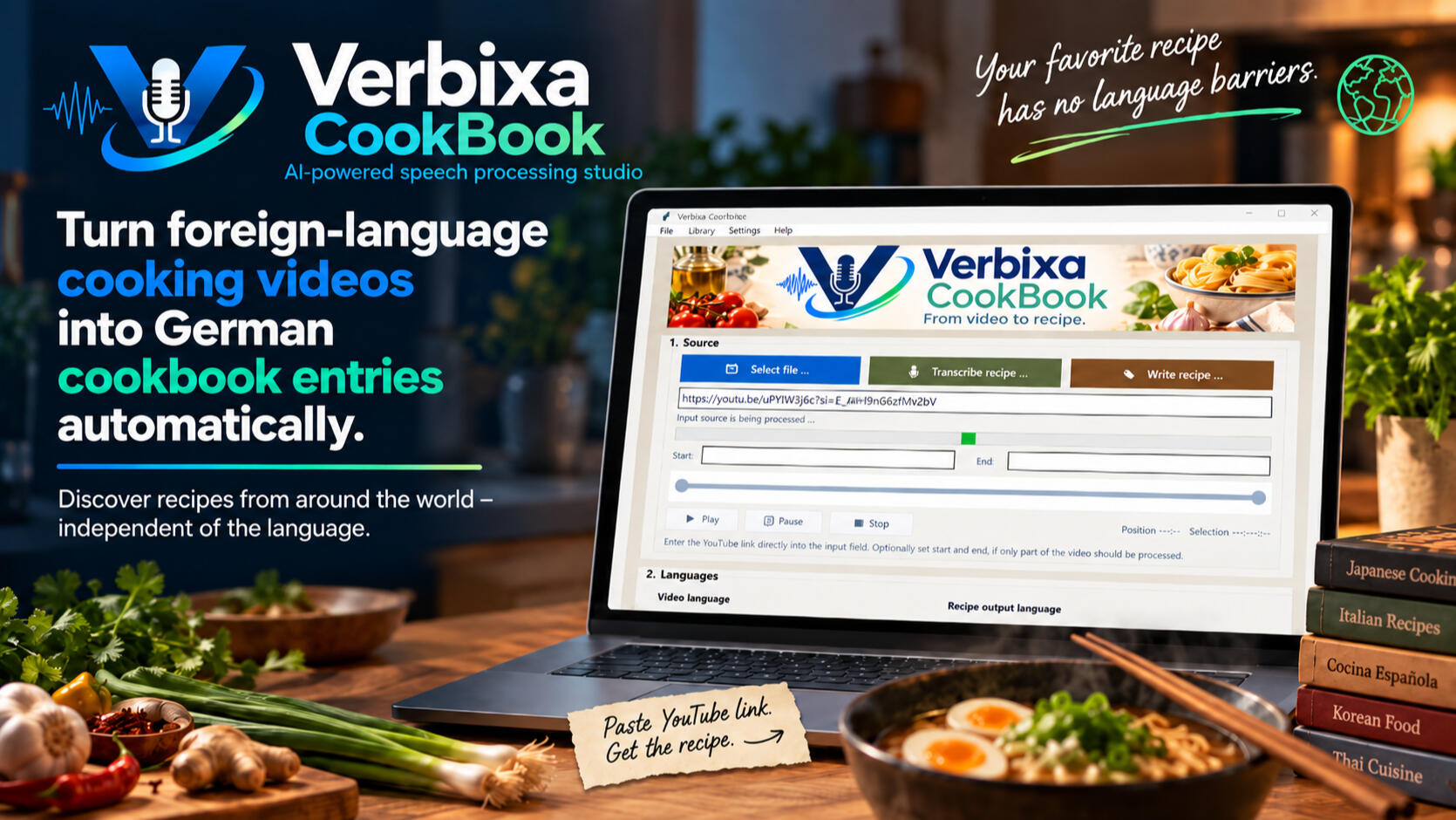
From Cooking Video to Recipe
Turn cooking videos, spoken recipes, and recipe texts in different languages into structured cookbook entries for your personal recipe collection.
Thanks to Verbixa, your favorite recipe knows no language barriers.
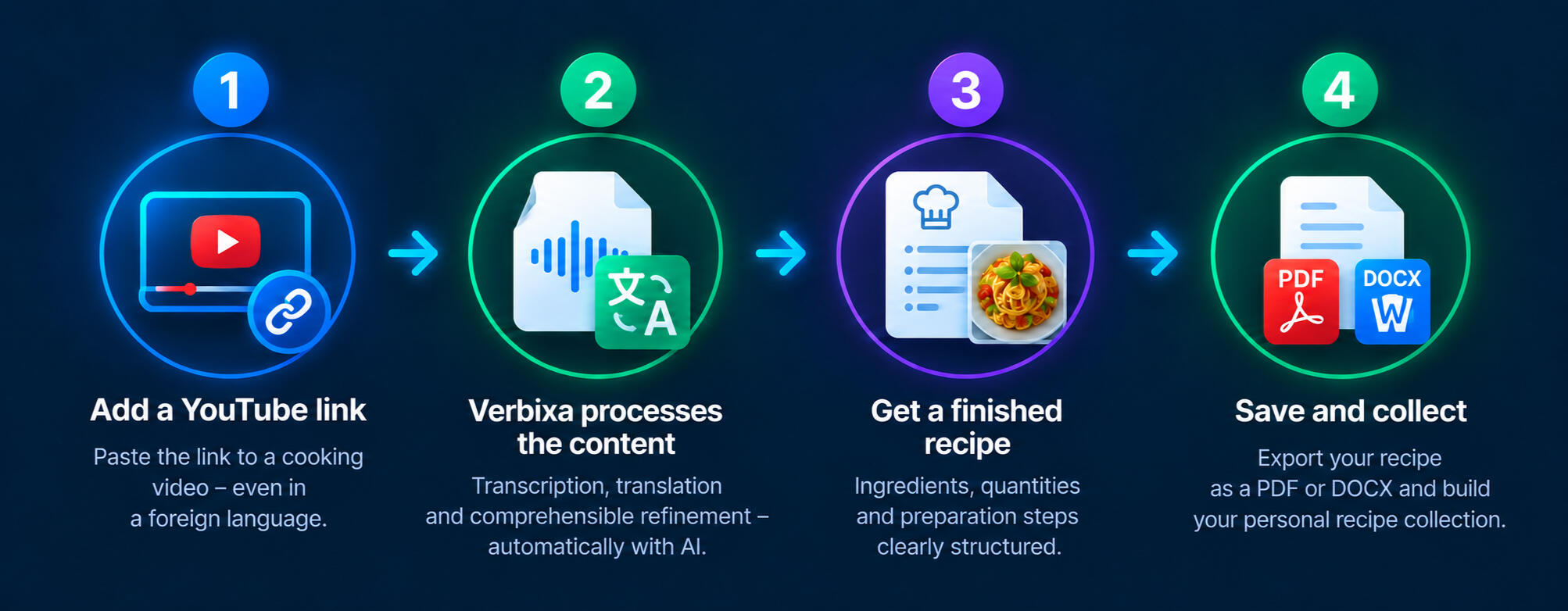
Turning a Cooking Video into Your Recipe Is This Easy
Not Just Cooking Videos:
Recipes from Audio, Speech, and Text
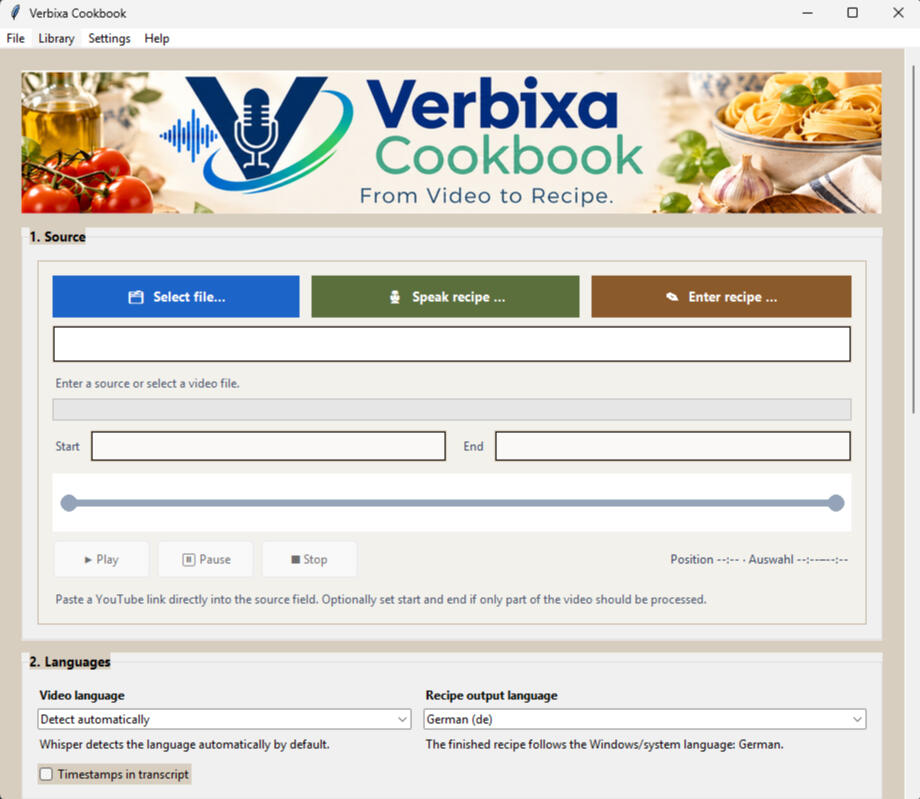
Verbixa CookBook isn’t limited to YouTube or traditional video files. You can process local audio and video files, dictate a recipe directly, enter recipe text manually, or import existing text from websites, PDFs, emails, or notes. This turns a wide range of source materials into a consistent, structured cookbook entry.
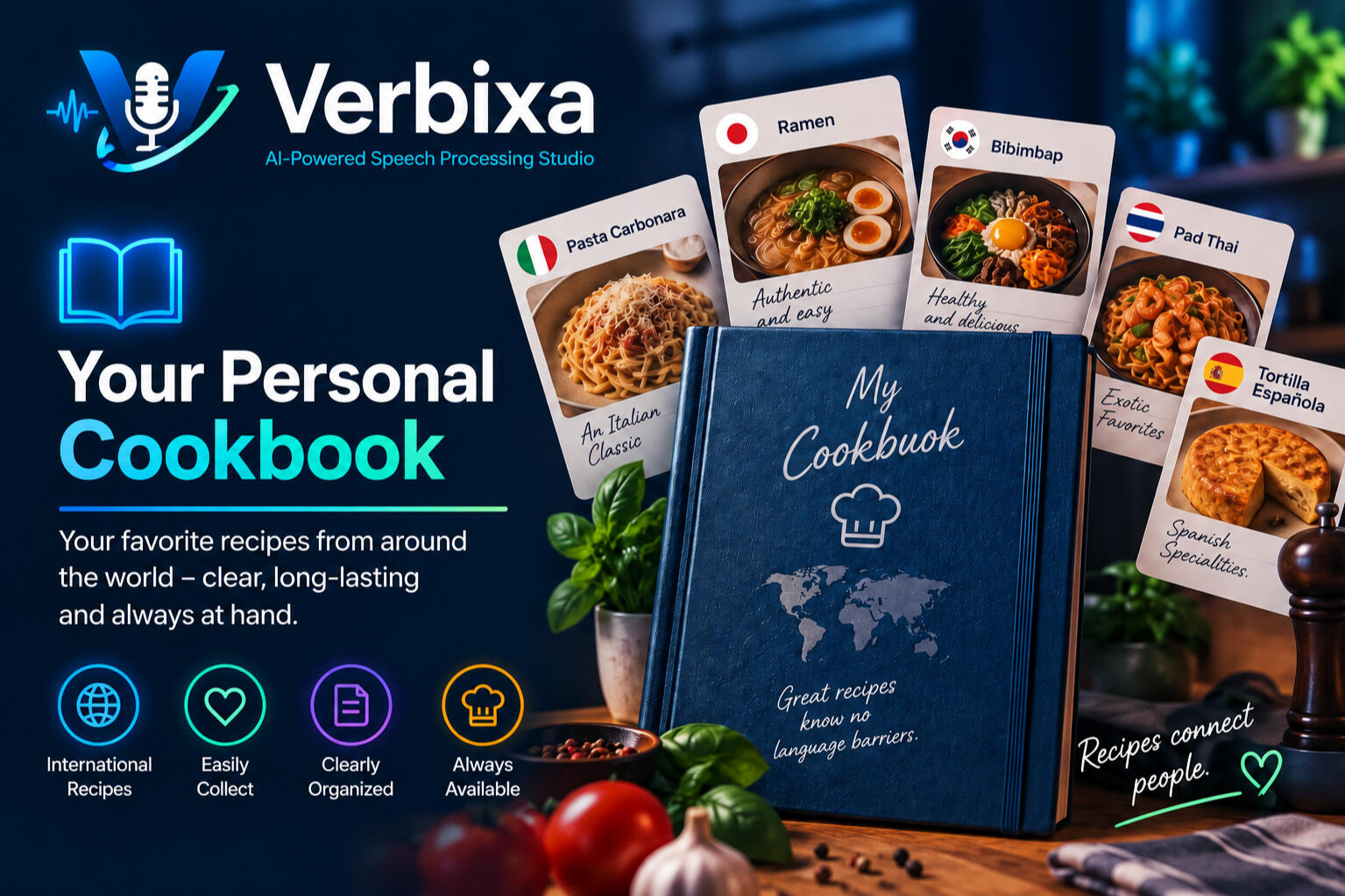
Audio & Video
Load local media and, if needed, process only the relevant time segment.
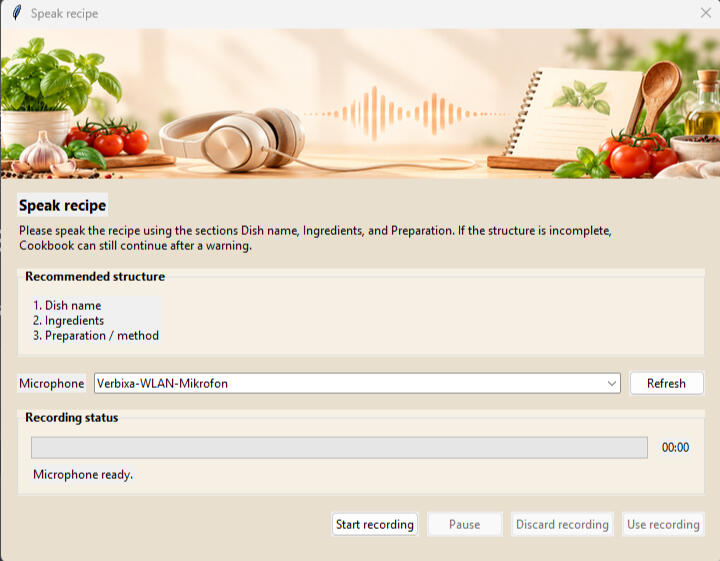
Dictate a Recipe
Record your own or family recipes directly using a microphone.
Enter a Recipe Manually
Enter ingredients, preparation steps, and additional details directly.
Import Text
Import existing recipe text from websites, PDFs, emails, or notes, translate it from other languages, and have it structured automatically.
Source-Faithful Instead of Made Up
Verbixa CookBook reconstructs recipes from the source material that is actually available. Missing ingredients, quantities, temperatures, cooking times, or preparation steps are not simply added from general cooking knowledge. If relevant information remains unclear, Verbixa can flag the uncertainty instead of inventing a seemingly complete answer.

Make Recipes from Around the World Accessible
The source language can be detected automatically. Foreign-language cooking videos, audio recordings, or recipe texts can be transcribed and—depending on the selected workflow—translated into the current Verbixa content language. This makes it possible to permanently incorporate recipes from international sources into a consistent personal recipe collection.
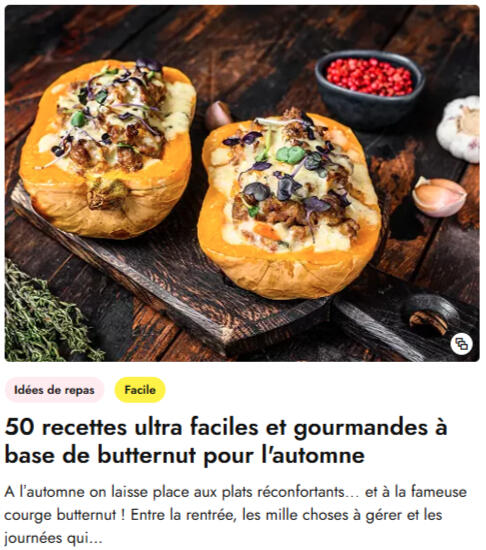
Turn Raw Material into a Structured Cookbook Entry
Depending on the information available, Verbixa can structure elements such as the recipe title, a brief description, servings, ingredients, preparation steps, variations, serving suggestions, and editorial review notes. Empty or unsupported sections are not added artificially.
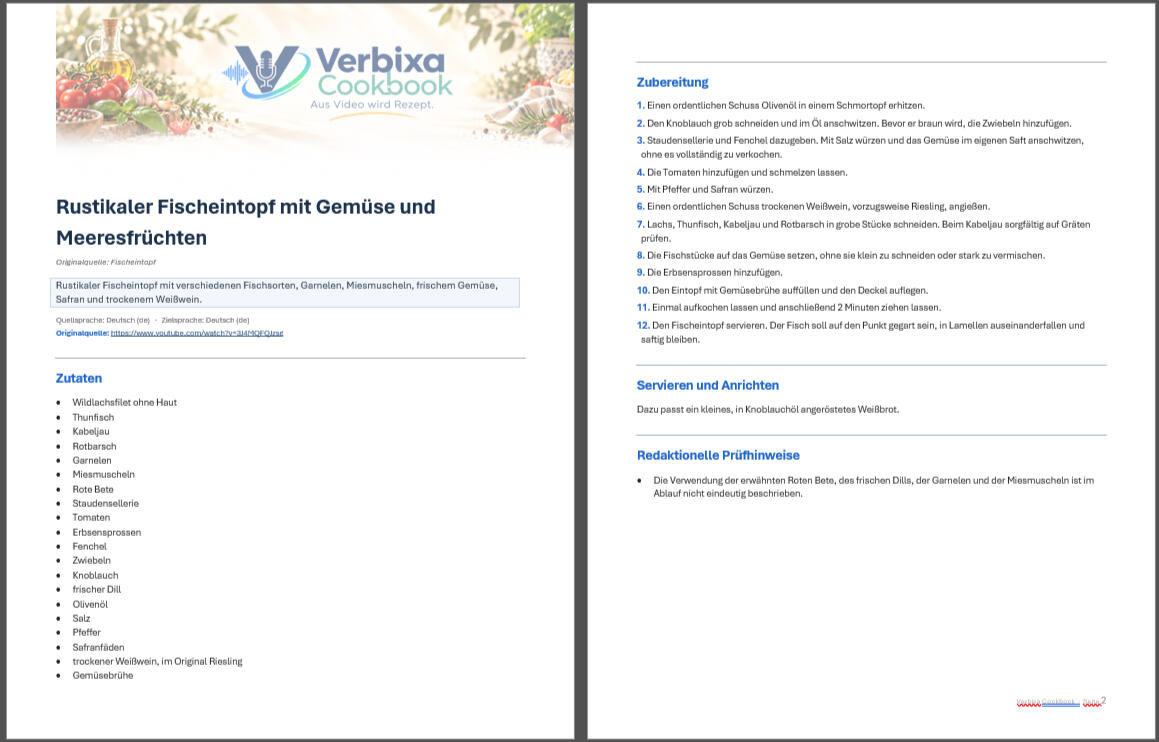
Save, Edit, and Collect
Finished recipes can be exported as PDF or DOCX files, with an additional TXT version generated as well. The recipes can then be organized, searched, filtered, and managed by custom categories in your personal recipe library.
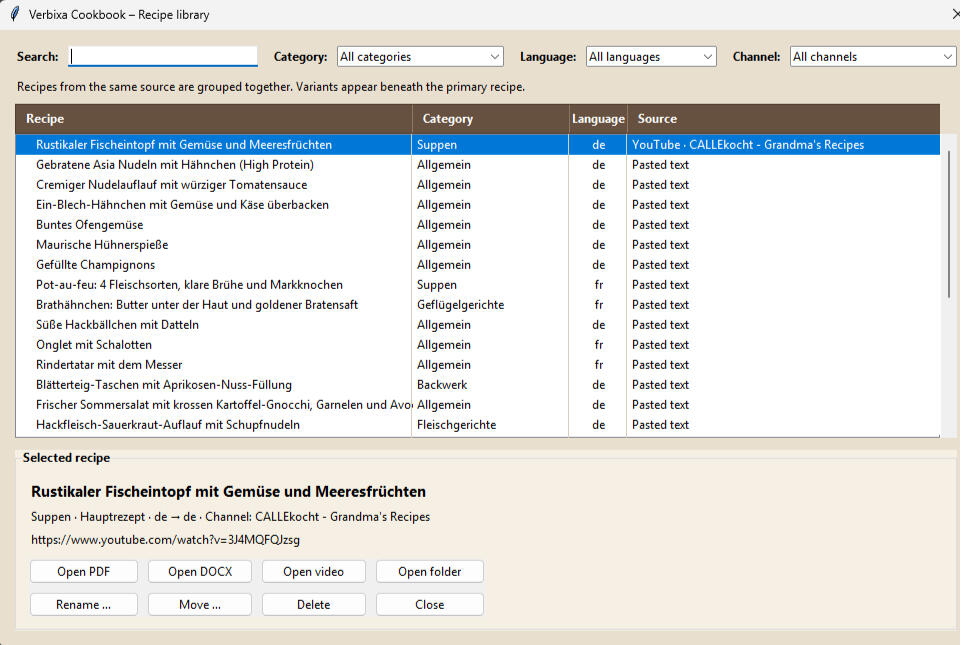
Clearly Manage Multiple Variations from the Same Source
Recipes from the same original source can be grouped together and organized as variations of a primary recipe. This keeps different versions easy to track without cluttering your library with uncontrolled duplicates.
Preserve Recipes That Were Never Written Down
Not every great recipe is written down in a cookbook or on a website. With Verbixa CookBook, you can dictate your own recipes or recipes passed down by word of mouth. The recording is processed and saved as a structured cookbook entry in your personal collection.
This turns a family recipe passed down by word of mouth into a recipe that can be preserved for generations.
Know Where a Recipe Came From — Even Later
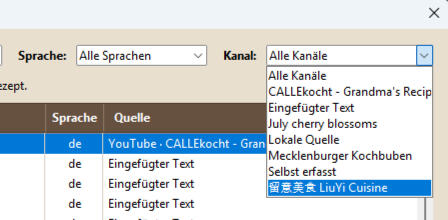
Verbixa CookBook keeps track of where your recipes came from—whether from a local file, an online source, a dictated recipe, imported text, or manual entry. For supported online sources, available channel information can also be preserved. This makes it easy to trace where a recipe was originally found or captured.
Not Every Cooking Source Is a Complete Recipe
Some videos focus primarily on a cooking technique rather than presenting a complete recipe. Verbixa can handle this type of content accordingly instead of artificially constructing a recipe from it. If neither a recipe nor a relevant cooking technique can be reconstructed reliably, the application can clearly indicate that.
You Decide How AI Is Used
Verbixa CookBook supports different AI configurations. Speech recognition can be performed locally. For more advanced AI features, either configured AI services or local models via Ollama can be used, depending on the workflow, configuration, and available hardware. Local AI processing requires Verbixa CookBook to run on suitable hardware.
Standalone — and Part of the Verbixa Suite
Verbixa CookBook works as a standalone application while also integrating with the Verbixa Suite. Existing recipe collections from Verbixa Studio can be incorporated into the CookBook library.
Try and Purchase Verbixa CookBook
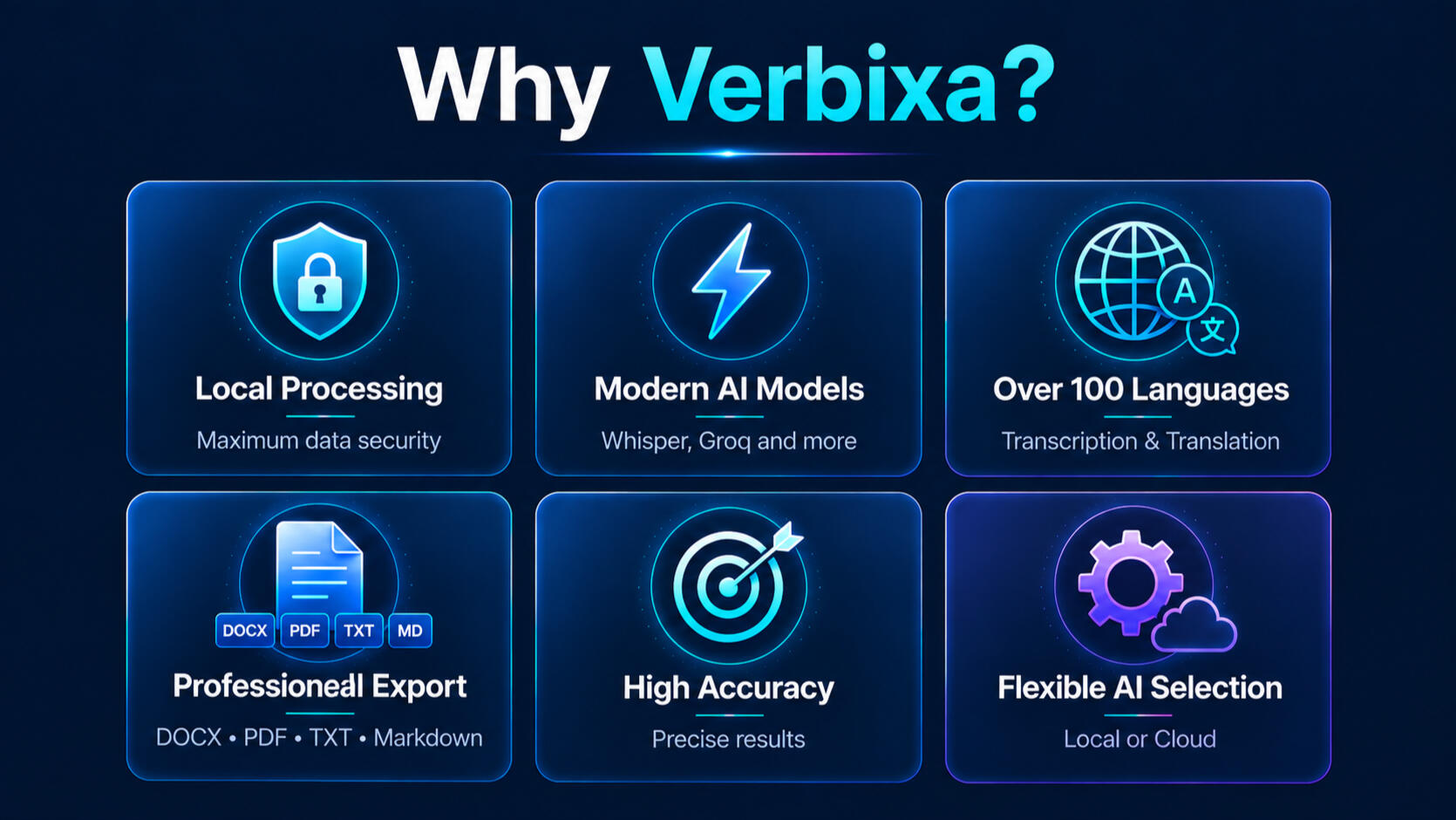
Modern AI models, a powerful desktop workflow, and maximum flexibility — locally or in the cloud.
Frequently Asked Questions
What Is Verbixa CookBook?
Verbixa CookBook is an application for turning existing cooking information into structured cookbook entries. Source material can include cooking videos, audio recordings, spoken recipes, and existing recipe text. The focus is on faithfully reconstructing the information actually present in the source and making it permanently usable in a personal recipe library.
What Sources Can Verbixa CookBook Process?
CookBook supports multiple input methods. These include local audio and video files, supported online sources such as YouTube, recipes dictated directly into the application, structured manual entry, and imported free-form text.
Can Verbixa Create a Recipe from a Foreign-Language Cooking Video?
Yes. Verbixa can detect the language of the video, transcribe the spoken content, and—depending on the selected workflow—translate it. It then uses the cooking information actually contained in the source to create a structured cookbook entry.
Do I Need to Understand the Language of the Source Material Myself?
No. The source language can be detected automatically. Foreign-language videos, audio recordings, or recipe texts can then be processed in the currently selected Verbixa content language.
Which Languages Does Verbixa CookBook Support?
The user interface and language selection currently support German, English, French, Spanish, Italian, Dutch, Polish, Czech, Greek, Russian, Ukrainian, Portuguese, Turkish, Hungarian, Thai, Japanese, Korean, and Chinese, among others. The underlying speech recognition system can also automatically detect additional languages.
Does Verbixa Automatically Identify Ingredients, Quantities, and Preparation Steps?
Verbixa attempts to reconstruct ingredients, quantities, preparation steps, and other recipe information from the source and present them in a structured format. What matters, however, is which information is actually present or can be reconstructed reliably.
Are Missing Ingredients or Quantities Added Automatically?
No—that is exactly what Verbixa CookBook is designed to avoid. Missing ingredients, quantities, temperatures, cooking times, serving sizes, or preparation steps are not simply invented based on general cooking knowledge. If relevant information is missing or uncertain, it can be omitted or flagged for review.
What Happens with Incomplete or Contradictory Sources?
CookBook distinguishes between information that is explicitly supported, information that can be reconstructed reliably, and information that is merely plausible. Only sufficiently supported details should be included in the cookbook entry. Any practically relevant uncertainty can be flagged with an editorial review note.
What Elements Can a Generated Cookbook Entry Include?
Depending on the information available, an entry can include the recipe title, a brief description, servings, ingredients, preparation steps, variations, serving and plating suggestions, and editorial review notes. Unsupported or empty sections are not added artificially.
Can Verbixa Also Process Cooking Techniques?
Yes. If a source primarily contains a cooking technique rather than a complete recipe, CookBook can turn it into an appropriately structured technique entry. If neither a recipe nor a relevant cooking technique can be reconstructed with sufficient confidence, the application should indicate this instead of inventing a recipe.
Can I Dictate My Own Recipe Directly?
Yes. With “Dictate a Recipe,” you can record a recipe directly using a microphone. The application supports recording, pausing and resuming, stopping, and then using the recording for further processing.
Is It Also Suitable for Family Recipes?
Yes. Recipes passed down orally within families are one of the intended use cases. A recipe that has previously existed only as a spoken tradition can be recorded, structured, and then permanently stored in the recipe library.
Can I Also Use Existing Recipe Texts?
Yes. Recipe text can either be entered manually in a structured format or pasted as complete free-form text. Suitable source material includes text from websites, PDFs, emails, chats, or notes. CookBook then attempts to extract the relevant recipe components.
Can I Process Only a Specific Section of a Long Video?
Yes. For longer media files, you can specify a start and end point. An audio preview is also available, allowing you to process only the section that contains the actual recipe, for example.
Does Every YouTube Video Work?
Not necessarily. CookBook includes mechanisms designed to work with current YouTube access methods. However, individual videos may not be processable due to platform changes, access restrictions, sign-in requirements, or technical characteristics of the source. Therefore, the website should not claim that every YouTube video will work.
Can I Edit the Generated Recipe Afterwards?
Yes. Recipes can be exported as DOCX files and then edited further, for example in Microsoft Word. In addition, library entries can be renamed, moved, and managed.
Which Export Formats Are Available?
CookBook can generate recipe documents as PDF and DOCX files for use with Microsoft Word. A TXT version is also created. The PDF and DOCX files use the same recipe structure and content.
Can the Original Transcript Be Saved Together with the Recipe?
Optionally, additional source information can be appended to the recipe documents. This can include a cleaned-up translation of the transcript and/or the cleaned-up original transcript. These attachments are disabled by default.
What Is the Recipe Library?
CookBook manages generated recipes in its own library. You can create custom categories or subfolders and organize your recipes over the long term. The structure is not fixed and can be adapted to suit your personal recipe collection.
Can I Search and Filter My Recipes?
Yes. The library provides search and filtering options, including by keyword, category, language, and source or input channel. Information displayed can include the recipe name, category, language, and source.
Can I Still Tell Where a Recipe Came From?
Yes. Verbixa stores metadata about the origin of a recipe. It distinguishes, for example, between local files, online or YouTube sources, dictated recipes, manual entries, and imported free-form text. For YouTube sources, available channel information can also be retained.
What Happens If I Process the Same Source More Than Once?
Recipes created from the same original source can be linked and displayed as variations of a primary recipe. If a conflict occurs, you can choose to use an existing version, create a new variation, or assign a different name.
Does Speech Recognition Run Locally?
Speech recognition can run locally. This means the audio material does not necessarily need to be sent to an external speech recognition service for transcription alone.
Can Verbixa CookBook Use Local AI?
Yes. On suitable hardware, local AI models can be used via Ollama. Availability depends in part on the system resources available.
Can Verbixa CookBook Work Completely Offline?
Not every workflow can operate completely offline. Local speech recognition and local AI processing are possible, but accessing YouTube or using configured cloud-based AI services, for example, requires a network connection.
Do I Need an API Key?
For local AI processing using properly configured local models, no cloud API key is required. If external AI services are used, the corresponding credentials or API keys may be required. CookBook supports setting up and validating these credentials.
How Are API Credentials Stored?
On Windows, newly stored API keys are protected using Verbixa’s credential infrastructure. According to the documented implementation, they are stored using Windows DPAPI within the current user context.
Does Verbixa CookBook Work as a Standalone Application?
Yes. CookBook is a standalone application and also part of the Verbixa Suite. Among other things, Verbixa Studio can be opened directly from CookBook, and existing recipe collections from Studio can be incorporated into the CookBook library.
What Language Is the User Interface Available In?
Verbixa CookBook currently has a German and an English user interface, with additional language versions planned. The source language, content language, and language of the generated documents are handled independently of the interface language.
Can I Try Verbixa CookBook Before Purchasing?
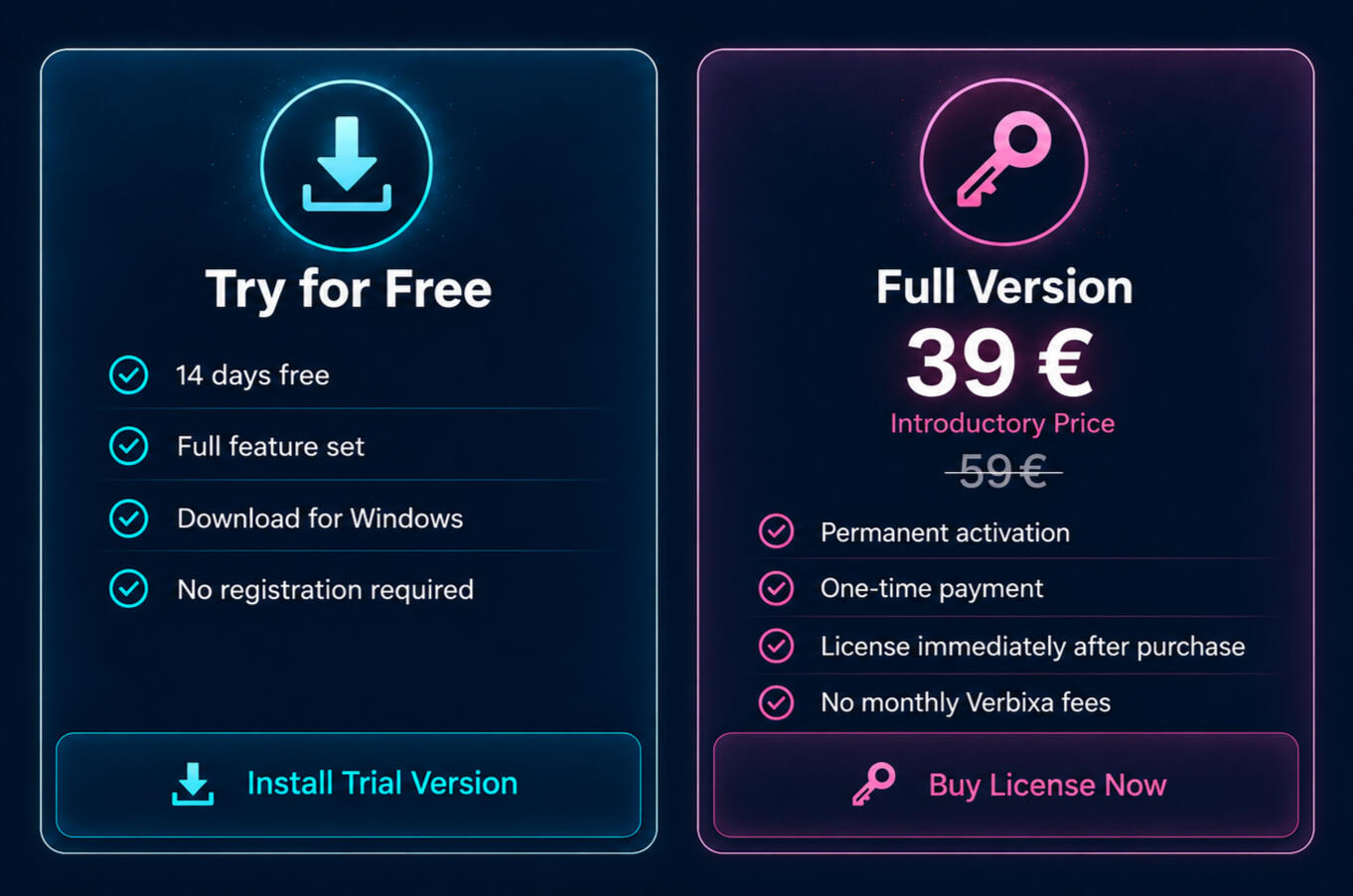
Yes. CookBook has its own trial and license management. Under the model currently planned for your website, the full version can be tested free of charge for 14 days. After that, an appropriate license is required to create new recipes; existing library functions can be handled separately. The 14-day period comes from your current sales model, while the technical feature description itself only documents support for a trial-version state.
Is Verbixa CookBook a Subscription?
Under the current sales model, CookBook is unlocked with a one-time payment. There are no monthly Verbixa fees. Any costs for external AI services are separate and may apply if the user configures such services.
Which Operating Systems Does Verbixa CookBook Run On?
Windows 10 and Windows 11, 64-bit.
© 2026 Mathias Scholz — Verbixa-Projekt
Made for creators, researchers & professionals.
Datenschutzerklärung
1. Verantwortlicher
Verantwortlich für diese Website ist:Mathias Scholz
E-Mail: [email protected]
2. Hosting
Diese Website wird über Carrd.co bereitgestellt. Beim Besuch der Website werden durch Carrd.co bzw. die eingesetzten Hosting-Dienstleister automatisch technische Informationen (Server-Logfiles) verarbeitet. Hierzu können insbesondere gehören:
IP-Adresse
Datum und Uhrzeit des Zugriffs
Browsertyp und Browserversion
verwendetes Betriebssystem
aufgerufene Seiten
Referrer-URL
Die Verarbeitung erfolgt zur Bereitstellung, Sicherheit und Stabilität der Website.
3. Kontakt per E-Mail
Wenn Sie mich per E-Mail kontaktieren, werden die von Ihnen übermittelten personenbezogenen Daten ausschließlich zur Bearbeitung Ihrer Anfrage oder Ihres Feedbacks verwendet.Eine Weitergabe an Dritte erfolgt nicht, sofern keine gesetzliche Verpflichtung besteht.
4. Downloads
Der Download der Software wird über GitHub bereitgestellt. Beim Aufruf der Downloadseite oder beim Herunterladen der Dateien können durch GitHub technische Informationen (z. B. IP-Adresse sowie Zugriffs- und Protokolldaten) verarbeitet werden.Es gelten ergänzend die Datenschutzbestimmungen des jeweiligen Anbieters.
5. Ihre Rechte
Sie haben im Rahmen der gesetzlichen Bestimmungen insbesondere folgende Rechte:
Auskunft über Ihre gespeicherten personenbezogenen Daten,
Berichtigung unrichtiger Daten,
Löschung Ihrer Daten,
Einschränkung der Verarbeitung,
Widerspruch gegen die Verarbeitung sowie
Beschwerde bei einer zuständigen Datenschutzaufsichtsbehörde.
6. Änderungen dieser Datenschutzerklärung
Ich behalte mir vor, diese Datenschutzerklärung bei Bedarf anzupassen, um sie an geänderte rechtliche oder technische Anforderungen anzupassen.